
A Century of Iron in Marion
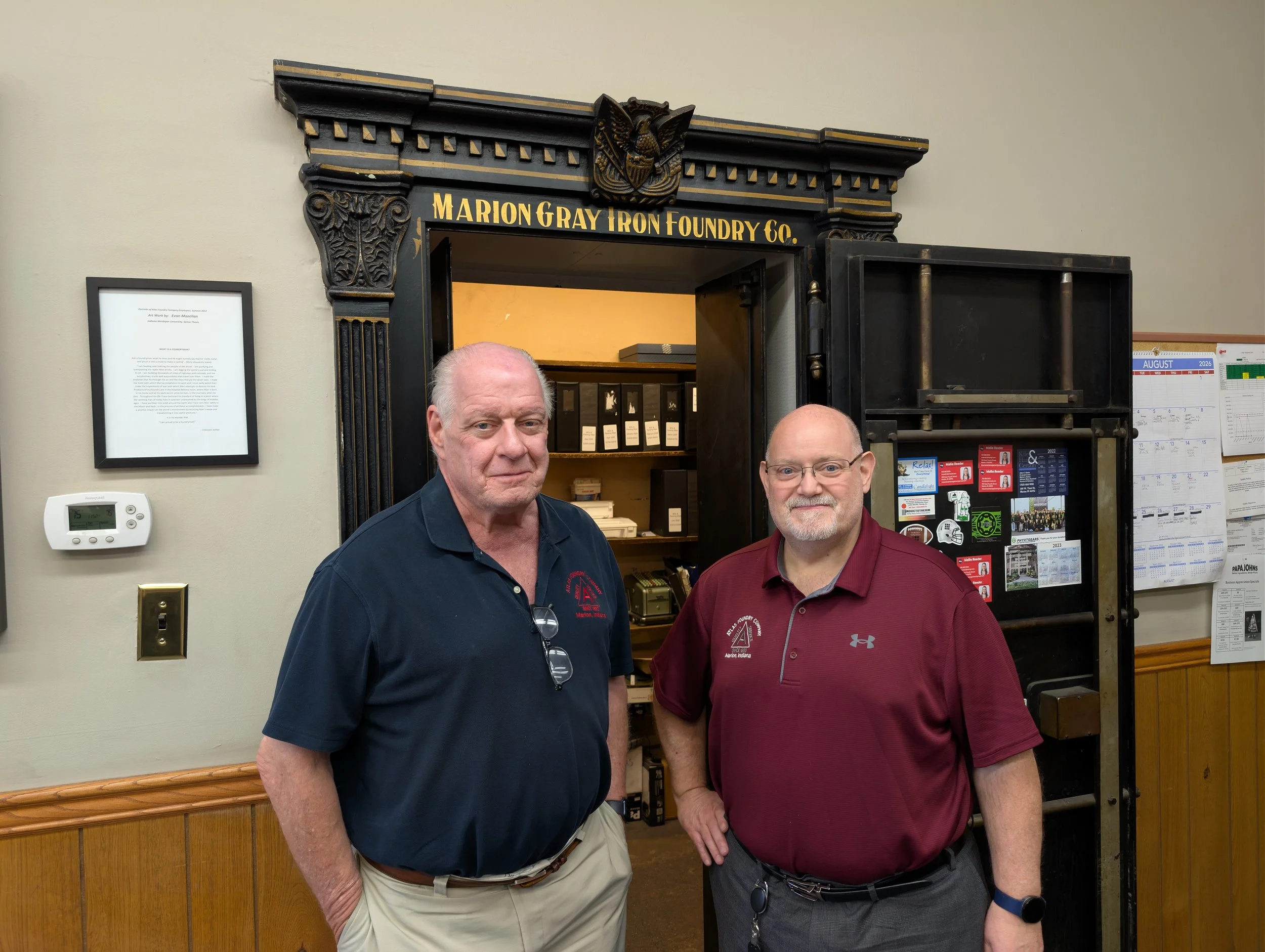
Photo of Jim Gartland (left) and Bill Gartland (right) at Atlas Foundry in Marion, Indiana.
A Chain of Foundries, Run from Marion
In 1923 a biographical directory recorded that Matthew Francis Gartland, of Marion, was president of eleven foundries operating across Illinois, Indiana, and Ohio. There was one in Terre Haute and one in Peru; others in Kankakee, Chicago, and Danville in Illinois, and in Toledo, Sandusky, Sidney, and Dayton in Ohio. Two were in Marion. He was also first vice-president and a director of the Dayton Malleable Iron Company, which controlled five malleable foundries of its own.
This is not the usual shape of a small-town manufacturing story. For roughly two decades around the turn of the last century, Marion was the head office of a multistate industrial enterprise, and the man running it was building a house here while opening plants in three states. He spaced them deliberately. He reckoned a new foundry could stand about every twenty-five miles, because iron was heavy, and the transportation of the day was slow and dear. His method of opening one was as much social as financial: he would gather foundry men he trusted, tell them what it would cost, and let each take a share; they issued stock, raised the money among themselves, and started the plant. The foundries often carried the names of the families who ran them, Gartland, Haswell, Carroll, and Rensselaer, who intermarried, sat on one another's boards and, now and then, traded their crossholdings to untangle a knot of part-ownerships.
Of those 11 foundries, two are still pouring iron today. One is in Terre Haute, and it survives as Gartland Foundry, now owned by the Grimes family, Betty Gartland having married Bill Grimes, which is how a branch of the chain passed to their line. The other is in Marion. Atlas Foundry Company has operated on the west side of the city since 1893, and it is the only one of the eleven that remained both in the founding family and in the county from which the whole enterprise was once directed. The question worth asking is not how it has lasted so long, but why this one, of all of them, is the survivor that stayed home. The archival record held by the Grant County Indiana Historical Society and the History Center at Marion Public Library, together with the recollections of Jim and Bill Gartland, answers that more usefully than any company profile does.
Twenty-Five Years Inside Other Men's Foundries
Matthew Gartland was born in Naugatuck, Connecticut, on March 13, 1854, the son of Patrick and Ellen Daley Gartland. He was educated in the public schools of that town, and at fourteen he entered the core department of the Tuttle and Whitmore Malleable Iron Company, where he worked for about six years. He went next to the National Malleable Castings Company in Cleveland, then, after a year, to the Youngstown Malleable Iron Company, then to Springfield, Ohio, as foreman of the core department at the Springfield Malleable Iron Company, where he stayed six years. In 1889 he came to Marion to take charge of the foundry of the Marion Malleable Iron Company, located at 9th and Miller.
He went out on his own in April 1893, at thirty-nine, having spent twenty-five years working in other men's foundries. He had left the Marion Malleable after falling out with the man running it, and for a short spell, a great reader, it is said, he sold books door to door before falling in with several of the town's foundry men. With two associates he founded the Marion Gray Iron Foundry Company and took the position of secretary and treasurer, which is what a 1901 state portrait directory still lists him as, alongside a vice-presidency at the Logansport Foundry Company.
The detail worth keeping is the apprenticeship. The founder of Grant County's oldest surviving manufacturer started in a core room at 14 and did not own anything for a quarter of a century.
Expansion, and the Price of Natural Gas
The expansion was rapid once it started. In November 1903 the Leader-Tribune reported that Gartland had been in Terre Haute closing on seventeen lots south of the Root glass factory, negotiating switch rights with the Evansville and Terre Haute railroad, and reviewing plans for a main building of 112 by 280 feet. He expected to employ 125 men at the outset. He would remain in Marion, where he was building a residence and already had a foundry, and a resident manager would be brought in from the east.
In February 1906 the Marion News-Tribune reported the next one. Gartland returned from Kankakee, Illinois, having bought an unfinished foundry building from the state treasurer, Len Small, and from William Fraser. A new Illinois company would be incorporated with paid-up capital of $100,000 and would start with between 75 and 100 employees, under P. V. Gartland. The Marion plant, then 12 years old and described as one of the city's most substantial industries, would be unaffected. No stock was to be offered publicly; it would be absorbed by the existing companies.
The 1903 report carries one more line worth pausing over. Discussing the outlook for Marion, Gartland noted that the price of natural gas across the Indiana gas belt was extraordinarily high that year, that gas was by then being piped into Marion from outside, and that some manufacturers were shutting off gas and burning coal instead. Grant County's industrial base was built on cheap gas. The gas did not last. The foundries that survived were the ones that adjusted to that fact, which is a reasonable description of the next 120 years.
The Depression, and a Change of Owners
Atlas came close to disappearing. Business had grown enough by 1911 to justify a second plant, near 26th and Adams streets in south Marion; an automatic conveyor was installed there in 1928. It was the newer and more mechanized of the two, a production foundry, and on cost alone it should have been the one to keep. During the Depression it lost the account it leaned on: Oldsmobile, its largest source of work, pulled that work back inside its own foundry. Atlas Foundry closed from 1932 to 1937; then, after a major strike in 1937, it was the older plant that reopened.
The south plant shut for good and was sold in 1941 to Paranite Wire and Cable, and operations consolidated on the Henderson Avenue site, where they remain. So the plant that survived was the older one, and it survived both a five-year closure and the loss of a marquee customer, an experience that led the family to swear off single-customer dependence generally, for good.
The name on the door moved around more than the address did. The company began as Marion Gray Iron, merged with Atlas during the Depression, and for a stretch was owned and run by the Gartlands' Peru Foundry, which operated the Marion plant under the assumed name “Atlas” while the legal entity remained Peru. As Jim Gartland tells it, the plant never really stopped, the wallpaper changed, not the work, but the name travelled from Marion Gray to Atlas to Peru and back to Atlas.
The Fire That Paid for It
The single most important piece of capital in Atlas's modern history did not come from a good year. It came from a fire. In 1981 the Peru plant burned down, and it was never rebuilt; the insurance settlement was turned instead toward Marion, funding the foundry's first Disamatic automated molding machine in the early 1980s. Around the same time the family bought out its remaining outside shareholders and took the company fully private, and the name settled, at last, on Atlas.
The record tends to credit the plant's survival to steady reinvestment and clever machinery. Jim Gartland credits the family, the decision, at a pivotal moment, to spend a windfall on the plant that had stayed in Marion rather than on the one that had burned.
A Capital Purchase Roughly Every Decade
Set the fire aside, and the underlying habit is still the clearest pattern in the archive: this company buys equipment, and has done so continuously for a century, generally in answer to a specific operating problem.
The 1928 conveyor came first. In 1957, the firm put up a new building and introduced a pallet line, a conveyor that carried molds from the molding area to the pouring floor and relieved molders of hauling castings that sometimes weighed a hundred pounds. That program was still running a decade later; by 1968 it had absorbed roughly $1M and raised capacity by about 150 percent. In 1974, the first automatic molding machine was built at Henderson Avenue. In 1976 the company was installing a wet-sand storage building to hold half a day's supply and recover the time previously lost preparing sand before a pour.
The modern era keeps the same rhythm. The first Disamatic went in during 1983, a second around the turn of the century, and the original was replaced in 2015. When American Seating, a customer, asked for a better grinding finish, the Gartlands installed an automated grinding cell through Vulcan Engineering Co. and ordered a second a year later.
Jim Gartland is wary of drawing too straight a line through all this. The equipment mattered, he says, but so did timing and no small amount of luck; a good deal of the efficiency “just fell into place.” What is not in doubt is the habit itself: nearly a hundred years of capital events, at intervals of roughly a decade, at a private company with no outside investors and no obligation to anyone but itself.
Tonnage, and the Cycle
A 1976 article in the Chronicle-Tribune supplies two numbers that belong together. In its first year of operation (1893), the foundry poured about 520 tons of iron. In 1974, its best year on record to that point, it poured 8,119 tons, against general predictions of a poor year. That is roughly sixteenfold growth across eight decades. Business in 1975 ran 60 percent below 1974. The record year and the collapse were consecutive.
This is the ordinary condition of a supplier to cyclical industries, and it is why the company's later insistence on spreading its exposure matters. By 2016, no single industry accounted for more than 20 percent of the product, and no single customer for more than 10 to 12 percent, across seven or eight industries. A firm that has lived through a 60 percent year does not need that lesson explained twice.
The Labor Problem Is Fifty Years Old
Skilled labor has always been the binding constraint in this trade, and it once bound tighter than any contract. When the family was starting the Peru foundry it could not find enough molders, the craftsmen who made each mold by hand and knew a given pattern fully. The men it needed were at the Gartland foundry in Terre Haute, then on strike, and their patterns had been loaded onto a rail car bound for Peru. The molders followed their patterns onto the train. A molder's patterns were, in a real sense, his job, and he was not about to let them leave town without him.
The modern shortage is the same problem. In 1968, the foundry employed about 175 people and expected to add 25 more. By 1976 it was installing sand storage in the hope of running two shifts. James Gartland told the Chronicle-Tribune that the company had tried two shifts before and were never able to hire enough qualified people.
That sentence was published fifty years ago. It is, almost word for word, what we hear now in conversations with manufacturers across Grant County.
We think this deserves more attention than it usually gets. The skilled-labor shortage in metal casting is routinely discussed as a recent development, variously blamed on the pandemic, on demographic change, or on the decline of shop classes. The local record does not support that framing. The shortage was already structural in 1976, during a period of strong demand and rising output, and structural enough to cap a profitable company's production at one shift. A problem that has persisted for five decades will not be solved by programs designed and funded in two-year cycles.
The Discipline of the Short Run
What the plant makes today is narrower than what it made in 1976, and the narrowing was deliberate. The foundry then produced castings up to 100 pounds, including parts for diesel truck engines and machine tools. It now specializes in Class 25, 30 and 35 gray-iron castings weighing less than 50 pounds, poured into vertically parted green-sand molds from Disamatic machines, with pattern development and storage, metal testing, prototyping, finishing, machining, coating and heat treating available around the pour. Its markets include trucking, agriculture, construction, pumps, hydraulic parts, compressors, bearings, stadium seating, marine equipment, and general industrial equipment.
Disamatic lines exist to run volume, and Atlas has spent four decades pointing them at the opposite problem. Jim Gartland has described the company as “a short-run Disa shop.” It prefers runs of one hundred to three hundred molds and has taken smaller ones for customers who could not find anyone else willing to.
This is a deliberate inversion of the industry's logic, and it is the closest thing the company has to a moat. Orphaned patterns and awkward low-volume parts are unattractive to high-throughput shops and uneconomic to send overseas. A customer with a difficult small part has few alternatives, a considerably stronger commercial position than competing on price per pound.
The best-known example sits at the end of a stadium row. The relationship began in the mid-1980s, when Jim Gartland was the first to call on American Seating of Grand Rapids, Michigan. A competitor from Fort Wayne had a lead on the work and offered to bring him along on condition that he keep his hands off the competitor's own parts; Jim agreed, then realized the work would not have fit the competitor's machines in any case. American Seating had shut down for two weeks without getting a run of parts made. Jim took a pattern home, ran two shifts that evening, and produced about a hundred pieces overnight. He had the job.
The parts were seat arms, the castings a cushion rests on, a right and a left for every chair. Atlas ran all the rights one day and all the lefts the next, so each arrived sorted in its own box, where the previous supplier had shipped them mixed and left the customer to pick them apart. When American Seating rang to ask how the parts kept turning up already separated, the answer was simply that Atlas used a different pattern for each hand and never mixed the runs. The buyer brief, Jim recalls, had been blunt: he did not want the price beaten; he just wanted out of his old foundry.
Four decades on, the relationship holds, though the customer's name has changed. In 2017 American Seating sold its stadium-seat division to Irwin Seating, also of Grand Rapids, and Atlas's stadium work continues with Irwin; American Seating itself remains in business, now concentrated on other kinds of seating. The stadium standards, the cast ends that anchor a row of seats, Atlas has made since 1994, using inserts and 10 universal patterns, one of which can be adjusted to produce 25 designs, stepping up in degrees to follow the incline of the rows. They are in Busch Stadium, Wrigley Field, and the Chicago White Sox ballpark, in professional and college venues, and in high-school fields in towns as small as La Joya, Texas. The first went into the Ballpark in Arlington, in 1994. The work is about a tenth of annual business, and more when other industries slow; when a dock strike in 2015 threatened American Seating's supply, Atlas poured an extra 15,000 castings to close the gap.
What This Means for Grant County
Atlas is not the county's largest employer. Its significance is of a different kind, and both the archive and the arithmetic sharpen it. In 1974, the industry counted around 5,000 iron foundries in the United States; today it counts around 500-600. Marion's own roll is a fair sample of the national one: Bahr Brothers still operates here, but Pope's, the West Point foundry, the shops in Gas City, and the old Marion Tool site have all vanished; some so completely that their only trace is the black foundry sand still in the ground. Much of that loss dates to the early 1970s, when federal air-pollution controls arrived. They were good for the air and unaffordable for the small shops, many of which simply took what they had and left. The eastern malleable business the family once ran went a grander way, public, then absorbed, and finally reinvented as the aluminum maker Amcast, whose Gas City plant is itself now closed.
Against that background, the survivor's habits are the story. Eleven foundries were run out of Marion at the height of the Gartland chain; the one that remains here is the one whose owners stayed, and the record of local involvement is long and easy to verify. The Indiana Manufacturers Association inducted Atlas into its Manufacturers Hall of Fame in 2023, and Bill Gartland joined the association's committee leadership the following year. The company belongs to the American Foundry Society, the Indiana Cast Metals Association, the Indiana Manufacturers Association, the Greater Grant County Chamber of Commerce, and the Grant County Economic Growth Council; members of the family have served in the Growth Council's leadership across four decades. It runs summer internships for local high-school students, work that former interns remember years later. And it has been a quiet, consistent supporter of community causes.
The retention lesson is not that legacy manufacturers endure. 10 of 11 did not. It is that the survivor changed continuously, bought equipment in bad years as well as good, and once, decisively, with the insurance from a fire, narrowed its product range on purpose, diversified its customers after being taught the necessity, and kept its decisions inside the county. Each of those depends on conditions a community can influence at the margin: capital access, training pipelines, technical assistance, and attention paid before there is a crisis to respond to.
If you run a manufacturing business in Grant County, we would like to hear about it. Contact us at 765-662-0650 or communications@grantcounty.com.
Acknowledgment
The historical material in this post is drawn from collections held by the Grant County Indiana Historical Society and the History Center at Marion Public Library, and from a conversation with Jim and Bill Gartland at the foundry. We are grateful to all three for preserving and sharing Grant County's history.
Resources
"Atlas: All in the Family." Chronicle-Tribune [Marion, IN], 22 Feb. 1976, sec. A, p. 7. Grant County Indiana Historical Society and the History Center, Marion Public Library.
"Atlas Foundry Charts Its Path." Modern Casting, 1 Aug. 2016, www.moderncasting.com/articles/2016/08/01/atlas-foundry-charts-its-path.
"Atlas Foundry Company Inc." Purdue Manufacturing Extension Partnership, Purdue U, mep.purdue.edu/made-in-indiana/company/atlas-foundry-company-inc. Accessed 12 Aug. 2026.
"Atlas Foundry Marks 75th Year in Marion." Newspaper clipping, 27 Feb. 1968. Marion and Grant County File, Marion Public Library, Marion, IN. Publication title not recorded on the clipping.
"Bremen Companies among 2023 Manufacturers Hall of Fame Inductees." Northwest Indiana Business Magazine, 28 Sept. 2023, nwindianabusiness.com/industries/manufacturing-technology/manufacturing/bremen-companies-among-2023-manufacturers-hall-of-fame-inductees/59489/.
Gartland, Jim, and Bill Gartland. Personal interview. Conducted by Loretta Tappan, Atlas Foundry Company, Marion, IN, 27 Aug. 2026.
"Gartlands to Have Another Iron Foundry." Marion News-Tribune [Marion, IN], 23 Feb. 1906, p. 1. Marion Public Library.
"Indiana Manufacturers Association Names 2024 Leadership." Northwest Indiana Business Magazine, 26 Jan. 2024, nwindianabusiness.com/industries/manufacturing-technology/indiana-manufacturers-association-names-2024-leadership/61951/.
"Marion Man Builds Terre Haute Plant." Leader-Tribune [Marion, IN], 13 Nov. 1903, p. 1. Marion Public Library.
"Matthew F. Gartland." Indianapolis Men of Affairs, American Biographical Society, 1923. Reprint held in the Picture File, Marion Public Library, Marion, IN.
Men of Indiana. 1901, p. 479. Picture File, Marion Public Library, Marion, IN.
Price-Bodkin, Layla. "Atlas Foundry Share." City of Marion, Indiana, 1 Jan. 2018, cityofmarion.in.gov/news-events/atlas-foundry-2.